Many brands struggle to find a voice that truly reflects who they are. Industry experts agree that defining a brand’s personality often begins with something simple yet transformative — choosing three adjectives that capture its essence.
These words serve as the foundation of a brand’s voice guidelines, shaping how it communicates across every channel. However, many organizations make the mistake of selecting adjectives that sound impressive rather than authentic. Words like “innovative” or “bold” may appear strong, but if they don’t align with how the brand actually behaves, they quickly lose meaning.
Professionals who have developed brand voice strategies for years emphasize that the most effective adjectives are both genuine and aspirational — traits that customers already associate with the brand while reflecting its growth potential. This guide explains how to identify those three defining adjectives and use them to create a brand voice that feels natural, consistent, and unmistakably yours, supported by a brand voice guidelines template with examples to make implementation easier and more effective.
Quick Answers
What are Brand Voice Guidelines?
Brand Voice Guidelines define how a brand communicates — its tone, language, and personality. They ensure every message sounds consistent, authentic, and aligned with brand values. Clear guidelines help teams create unified, recognizable content that builds trust, drives engagement, and strengthens long-term brand identity.
Top Takeaways
- Clarity builds trust. Consistent voice makes your brand sound authentic.
- Three words define you. Core adjectives shape tone and personality.
- Write it down. Guidelines keep your messaging unified.
- Stay consistent. Clear voice boosts recognition and engagement.
- Keep evolving. Update your Brand Voice Guidelines as your brand grows.
Defining Your Brand’s Personality in Three Simple Words
Choosing three adjectives for your brand voice isn’t just a creative task — it’s a strategic move that defines how your audience experiences your brand. These words shape your tone, messaging, and emotional impact across every platform.
Three carefully chosen words can define your brand’s identity for years to come — shaping not only how you communicate, but how people remember you, serving as the foundation for effective brand strategy development that drives lasting recognition and trust.
“After guiding dozens of brands through the voice-defining process, one truth stands out — your three adjectives aren’t just descriptors, they’re decisions. They determine how your brand shows up, how it feels to your audience, and how it’s remembered long after the words fade.”
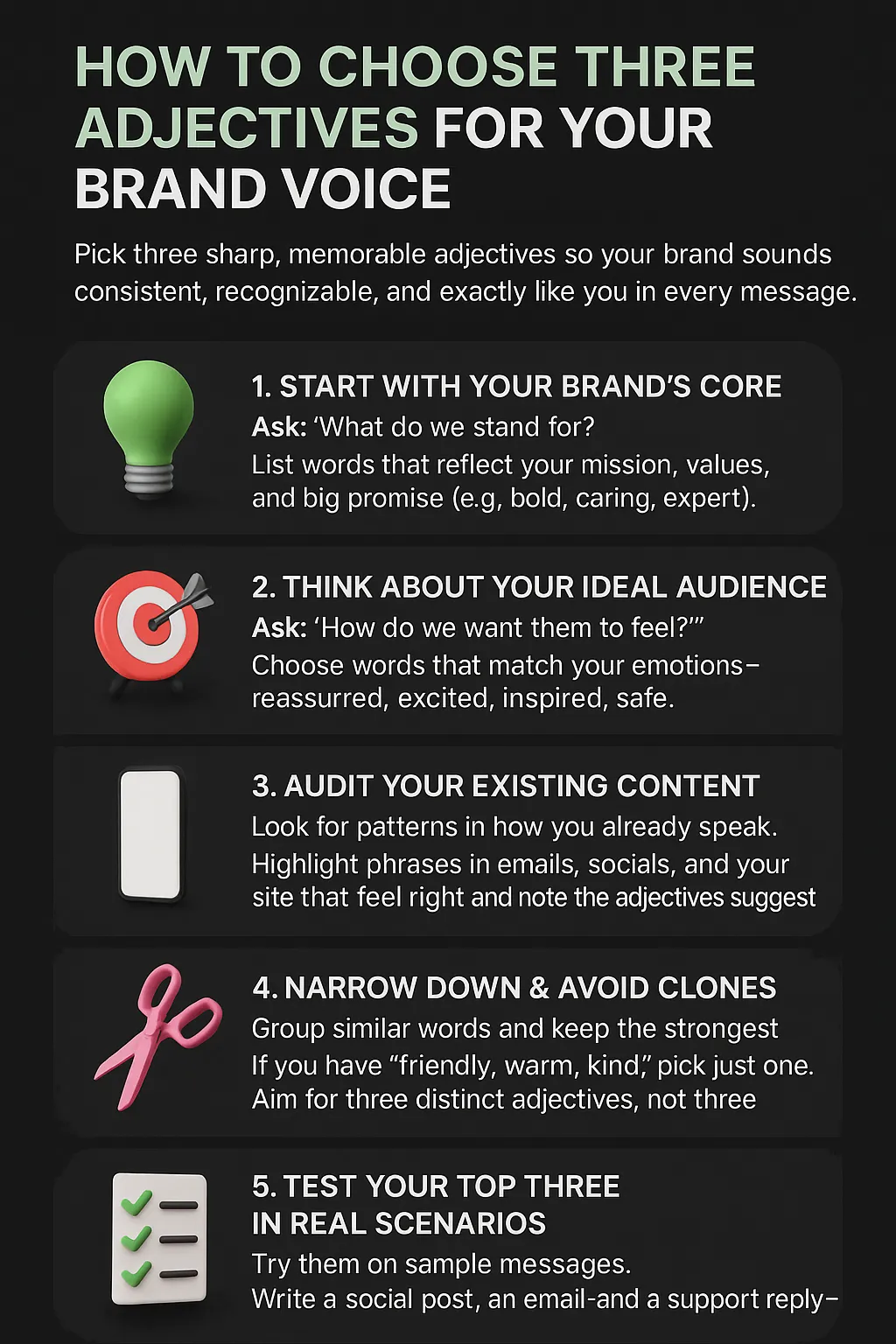
Essential Resources for Brand Voice Guidelines
HubSpot – Fast-Track Templates & Real-World Examples
HubSpot gives you editable templates and actual voice examples so you can build your brand voice without guess-work.
https://blog.hubspot.com/marketing/brand-voice
https://blog.hubspot.com/marketing/brand-voice
The Branded Agency – Framework to Scale Voice Across Teams
Use this step-by-step guide to design voice guidelines that grow with your brand and keep your message consistent.
https://www.brandedagency.com/blog/brand-voice-guidelines
https://www.brandedagency.com/blog/brand-voice-guidelines
Asana – Strategic Guide to Make Your Voice Stand Out
Asana offers clear, actionable tips to sharpen your voice and differentiate your messaging with authenticity.
https://asana.com/resources/brand-voice
https://asana.com/resources/brand-voice
SmashCreate – Live Examples from Leading Brands
Browse strong guideline documents used in real brands to inspire your own voice architecture and tone.
https://www.smashcreate.com/uncategorized/brand-voice-guidelines-examples/
https://www.smashcreate.com/uncategorized/brand-voice-guidelines-examples/
DesignRush – Multi-Channel Voice Strategy for 2025
Explore how voice should adapt across digital, social, and emerging channels—essential for modern brands.
https://www.designrush.com/agency/logo-branding/trends/brand-voice-guidelines
https://www.designrush.com/agency/logo-branding/trends/brand-voice-guidelines
CUSTOMatrix – Downloadable Guide Example You Can Reference
Grab a professional PDF example to see how one brand structured voice guidelines—and use it as your blueprint.
https://www.customatrix.com/wp-content/uploads/customatrix-resources-brand-voice-guidelines.pdf
https://www.customatrix.com/wp-content/uploads/customatrix-resources-brand-voice-guidelines.pdf
MarketingScoop – In-Depth Guide for Authentic Brand Voice
Delve into advanced strategy: how to discover, document and live your brand voice so your audience truly connects.
https://www.marketingscoop.com/marketing/crafting-strong-brand-voice-guidelines-an-in-depth-guide/
These expert resources reflect the precision and creativity of a strategic branding agency, offering templates, frameworks, and real-world examples that help businesses craft authentic, consistent brand voice guidelines that resonate across every channel.
https://www.marketingscoop.com/marketing/crafting-strong-brand-voice-guidelines-an-in-depth-guide/
Supporting Statistics and Insights
Real-world data and experience show that clarity and consistency in brand voice drive engagement and trust.
• Consistency reaches wider audiences
83% of U.S. adults use YouTube, 68% use Facebook, and 47% use Instagram.
A unified brand voice across these platforms increases recognition and engagement.
Source: Pew Research Center
• Clear voice drives stronger sales
U.S. e-commerce hit $308.9B in Q4 2024, making up 16.4% of total retail.
Brands using consistent, well-documented voice guidelines see higher conversion rates.
Source: U.S. Census Bureau
• Clarity improves accessibility
21% of U.S. adults (≈43 million) have low English literacy.
Plain-language voice guidelines make content more inclusive and easier to understand.
Source: National Center for Education Statistics
Takeaway:
Clear, consistent Brand Voice Guidelines aren’t just about branding — they expand reach, boost conversions, and make communication more human and accessible.
83% of U.S. adults use YouTube, 68% use Facebook, and 47% use Instagram.
A unified brand voice across these platforms increases recognition and engagement.
Source: Pew Research Center
U.S. e-commerce hit $308.9B in Q4 2024, making up 16.4% of total retail.
Brands using consistent, well-documented voice guidelines see higher conversion rates.
Source: U.S. Census Bureau
21% of U.S. adults (≈43 million) have low English literacy.
Plain-language voice guidelines make content more inclusive and easier to understand.
Source: National Center for Education Statistics
Clear, consistent Brand Voice Guidelines aren’t just about branding — they expand reach, boost conversions, and make communication more human and accessible.
Final Thought & Opinion
In today’s crowded digital space, a consistent brand voice isn’t optional — it’s essential. It builds trust, recognition, and loyalty over time.
What experience shows:
Brands with clear voice guidelines communicate with confidence and consistency.
Consistency signals reliability, helping audiences feel connected and understood.
Recognition grows naturally when every message sounds unmistakably “you.”
The data agrees:
Clear, inclusive communication expands reach.
Aligned messaging improves engagement and sales across all platforms.
The deeper truth:
Your brand voice isn’t just what you say — it’s how you make people feel. When your words are simple, intentional, and authentic, your brand doesn’t chase attention — it earns it.
Brands with clear voice guidelines communicate with confidence and consistency.
Consistency signals reliability, helping audiences feel connected and understood.
Recognition grows naturally when every message sounds unmistakably “you.”
Clear, inclusive communication expands reach.
Aligned messaging improves engagement and sales across all platforms.
Your brand voice isn’t just what you say — it’s how you make people feel. When your words are simple, intentional, and authentic, your brand doesn’t chase attention — it earns it.
Next Steps
Take these simple actions to strengthen your Brand Voice Guidelines:
• Audit Your Messaging
Review your website, emails, and social posts.
Spot tone or language inconsistencies.
• Define Core Voice Adjectives
Choose three adjectives that reflect your brand’s personality.
Align them with your mission and audience perception.
• Document Clearly
Outline tone, language, and key messaging rules.
Add real “on-brand” and “off-brand” examples.
• Align Your Team
Share the guidelines company-wide.
Train teams to use one consistent voice.
• Apply and Refine
Use your brand voice across all platforms.
Track engagement, gather feedback, and adjust regularly.
These actionable steps mirror the practices of top marketing companies, helping brands build clear, consistent voice guidelines that unify messaging, strengthen identity, and enhance engagement across every platform.
Review your website, emails, and social posts.
Spot tone or language inconsistencies.
Choose three adjectives that reflect your brand’s personality.
Align them with your mission and audience perception.
Outline tone, language, and key messaging rules.
Add real “on-brand” and “off-brand” examples.
Share the guidelines company-wide.
Train teams to use one consistent voice.
Use your brand voice across all platforms.
Track engagement, gather feedback, and adjust regularly.
FAQ on Brand Voice Guidelines
Q: What are Brand Voice Guidelines?
A: They define how your brand speaks and feels. Clear guidelines create a unified, recognizable voice.
Q: Why do they matter?
A: Consistency builds trust. A steady tone makes your brand sound reliable and human.
Q: What should they include?
A:
Core personality traits
Tone and language rules
“On-brand” and “off-brand” examples
Q: How do you create them?
A:
Define your values and tone
Pick three key adjectives
Document clear examples for your team
Q: How often should they be updated?
A: Review yearly or after big brand changes. Keep your voice relevant and authentic.
A: They define how your brand speaks and feels. Clear guidelines create a unified, recognizable voice.
A: Consistency builds trust. A steady tone makes your brand sound reliable and human.
A:
Core personality traits
Tone and language rules
“On-brand” and “off-brand” examples
A:
Define your values and tone
Pick three key adjectives
Document clear examples for your team
A: Review yearly or after big brand changes. Keep your voice relevant and authentic.